Getriggert durch das neue Video von Weissnichs Welt

hab ich mir mal wieder die Frage gestellt, wie lange man mit einmal gekaufter Hardware
halbwegs was verdienen kann. Der Ertrag an Bitcoins ist wohl umgekehrt proportional
zur gesamten Hashrate auf diesem Planeten, soweit mir das LLM das erklärt hat. Da ich
es noch nirgends mal fertig gefunden habe, hab ich jetzt mal mit claude.ai / opus 4.7 eine Simulation machen lassen, wie sich der Ertrag in Euro ct bei einer gegebenen fixen Hardware entwickelt, relativ zu Anfang 2020:
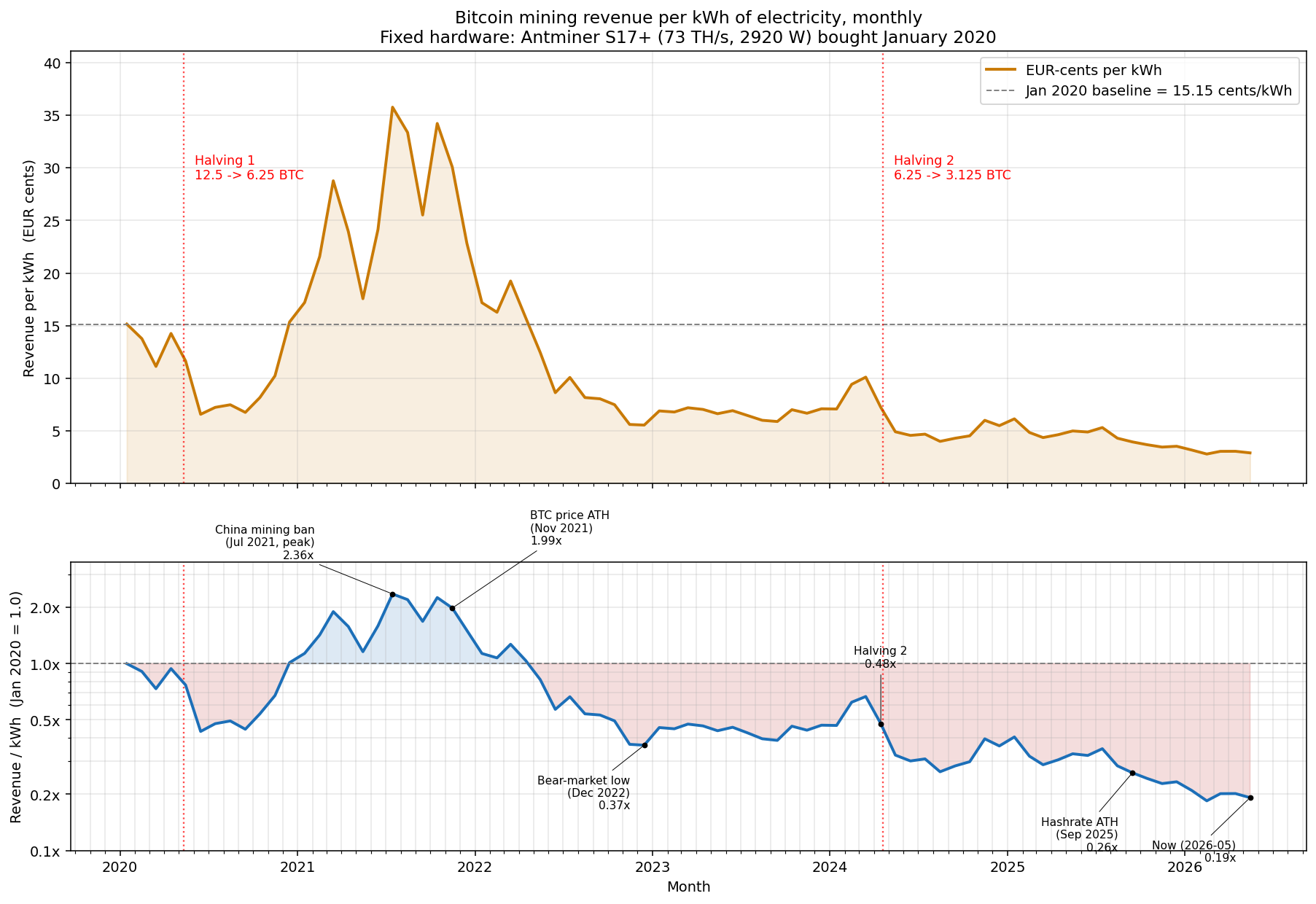
Betrachtet man so pi mal Daumen die etwas ruhigere Zeit von 2023 bis heute, kommt etwa auf einen Faktor 2.5 (von 0.5 auf 0.2x Anfangswert) den der Ertrag in 3 Jahren runtergeht.
Zusammenfassung
Here's what the analysis shows for a fixed bitcoin-mining ASIC bought at the start of 2020 (Antminer S17+, 73 TH/s @ 2920 W — though the normalized curve is hardware-independent because the miner's hash/W ratio is constant):
- Jan 2020 baseline: 15.15 EUR-cents per kWh of electricity consumed
- Jul 2021 peak: 35.77 c/kWh (2.36× baseline) — driven by the China mining ban cutting network hashrate ~45 % overnight
- Halving 2 (Apr 2024): instant 48 % revenue drop at the unit-energy level
- May 2026 (now): 2.91 c/kWh — only 0.19× baseline, i.e. ~5× less than at purchase
- First-year average: 10.6 c/kWh; last-12-month average: 3.7 c/kWh → the same hardware has "aged" to about 35 % of its early-life revenue density
The shape is driven by three forces: the two halvings (cliffs in May 2020 and Apr 2024), the ~10× growth in network hashrate (108 → 1066 EH/s) eroding the miner's share, and BTC/EUR price swings providing temporary lift. The hardware crossed the typical European industrial electricity tariff (~13 c/kWh) on the way down, and now needs sub-cent electricity to break even.
Sources:
